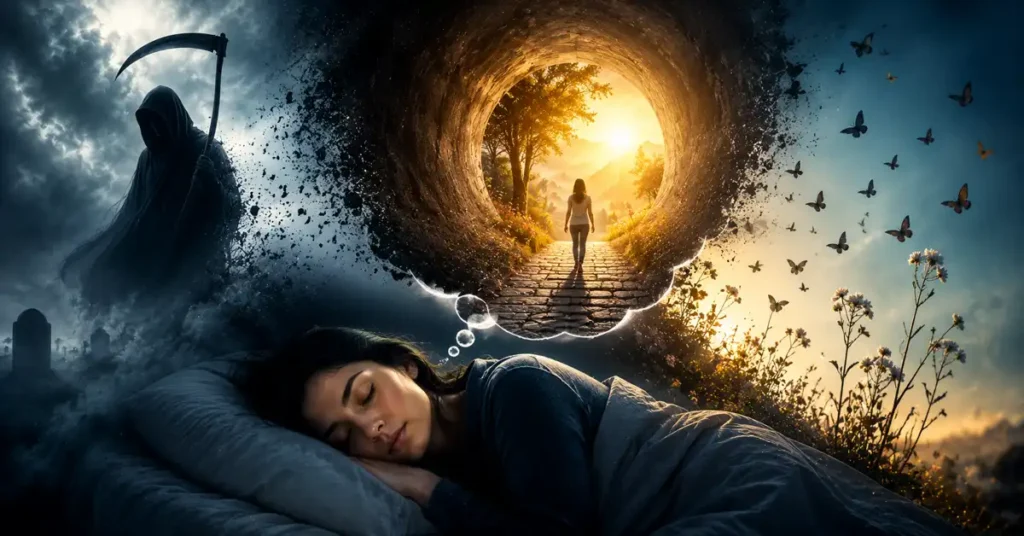
You wake up with your chest tight and the dream still vivid: you died. Or someone you love did. And before you’re even fully awake, the fear has already formed itself into a question — is this a sign? Is something going to happen?
Let me put your mind at ease the way a good friend would at 3am: death dream meaning is almost never literal. Dreaming about death is one of the most misread dreams there is — frightening, vivid, and almost universally misunderstood — but it’s very rarely a premonition, and almost never about actual dying. Far more often, it’s your mind’s way of processing an ending: a change, a transition, a chapter of your life quietly closing so another one can open.
Death in dreams = endings and transformation, not prophecy
Across dream psychology and most spiritual traditions alike, death shows up as a symbol of transformation. Endings, change, letting go, the close of one phase and the start of the next. Your dreaming mind reaches for the most dramatic image it owns — death — to represent something much less frightening than it feels: that something in your life is ending and becoming something else.
Notice how much your waking language already works this way. We talk about the “death” of a relationship, a “dead-end” job, putting an old habit “to rest,” a part of ourselves we’ve “killed off.” Your dreaming mind just makes that metaphor literal and cinematic. The sheer intensity of the image is the point — it’s matching the size of the change you’re moving through.
Want to understand your specific death dream? Susan, the AI astrologer inside Dream Chaser, can talk through the details with you — who died, how it felt, what was happening — and help you see what ending or change your mind is really processing. Try it free on iPhone →
What your death dream usually comes down to (by who’s dying)
The details shift the meaning. Here’s how the most common versions tend to read.
You dream of your own death. This is the one that scares people most, and ironically it’s often the most hopeful. Dreaming of your own death usually points to transformation — shedding an old identity, ending a chapter, becoming a new version of yourself. It tends to arrive during big transitions: a move, a breakup, a new job, leaving behind a relationship or a version of you that no longer fits. Terrifying in the moment; frequently a sign of growth underneath.
You dream that someone else dies. Rarely about them literally, and almost never a prediction. It usually means one of three things: a change in your relationship with that person, a quality they represent that’s shifting inside you, or your own anxiety about losing them. Our dream interpretation ai chatbot Susan works as a guide for your dreams and she can make you feel relaxed. A parent dying can symbolize your growing independence; a partner’s death, a changing dynamic between you rather than a real threat.
You dream of a loved one who has actually died. These dreams are often less about fear and more about love. They tend to reflect grief being processed, or what psychologists call “continuing bonds” — your mind keeping a connection alive. Many people find these dreams comforting, like a visit. If they leave you tender rather than scared, that’s usually exactly what they’re meant to do.
You’re told of a death, or you’re at a funeral. Funerals in dreams are about closure. They often represent a definitive ending you’re acknowledging — the part of you that’s finally ready to say goodbye to something and lay it to rest.
Why death dreams tend to show up when they do
Death dreams cluster around thresholds. They surface during major transitions, endings, and decisions — and during grief, which makes sense, since grief is the mind working through the biggest ending of all. Milestone birthdays, the end of a relationship, leaving home, a career change, or even just a creeping sense that one season of your life is closing can all summon death imagery.
Sometimes, too, a death dream is about the change you’re avoiding rather than the one you’re in. If part of you knows a chapter needs to end and you keep putting it off, your mind may stage the ending for you — not unlike the way a dream of being chased dramatizes the thing you’re running from. The dream isn’t a threat. It’s a nudge.
The transformation thread (older than you think)
Across cultures and centuries, death imagery in dreams has been tied to rebirth far more than to ending. The phoenix burning to rise again. The seed that has to break open to grow. The snake shedding its skin — which is exactly why a snake in a dream so often points to transformation rather than threat. Different image, same ancient idea: something has to end for something new to begin.
You don’t have to believe in any symbolism to put this to use. A death dream is your psyche pointing at a doorway and asking whether you’re ready to walk through it.
What it almost never means
Let’s say the quiet part out loud, because it’s the part keeping you up: a death dream is not a premonition. It does not predict your death or anyone else’s. It is not an omen, a warning from the universe, or a sign that something bad is coming. Dreams don’t work as forecasts — they work as processing. The fear you woke up with is real and valid, but it’s pointing inward at a change, not forward at a fate.
The question worth asking
Instead of “what’s going to happen,” turn it around: what in my life is ending, changing, or asking to be let go of?
Sometimes the answer is obvious — a relationship, a job, a city, a friendship. Sometimes it’s subtler: an old belief about yourself, a role you’ve outgrown, a way of coping that used to work and doesn’t anymore. The death dream tends to quiet down once you name the ending and let yourself actually grieve or honor it, rather than bracing against it. Endings, even chosen ones, deserve to be mourned a little.
When death dreams point to something heavier
Most death dreams are a normal, even healthy, way of processing change. But if they come alongside persistent grief, a real fear of dying that follows you into your waking hours, a low or hopeless mood, or recurring distress you can’t shake, that’s worth taking gently seriously. Grief in particular can stir up vivid, repeated dreams, and it’s a lot to carry alone — much the way recurring dreams of drowning or being overwhelmed by water can reflect real emotional overload.
None of this means anything is wrong with you. But if the feeling around these dreams is heavy and it’s lingering, talking with a therapist, a grief counselor, or someone you trust isn’t an overreaction — it’s a kind thing to do for yourself. You don’t have to sit with the big endings by yourself.
The bottom line
Death dreams are about transformation, not termination. The image is dramatic on purpose, because the change it’s pointing to is real — but the message underneath is almost always gentler than the dream felt. Something is ending. Something is being made room for. A version of you is ready to become the next one.
So the next time you wake from a death dream with your heart pounding, try not to ask what’s coming for you. Ask, instead: what am I ready to let go of — and what’s waiting to begin?
Woke up shaken by a death dream? Tell Susan what happened and how it felt — she’ll help you separate the fear from the meaning and figure out what ending your mind is really working through. Talk to Susan free on Dream Chaser →
Frequently asked questions
Does dreaming about death mean someone is going to die? No. Death dreams are not premonitions and don’t predict anyone’s death. They almost always symbolize endings, change, or transformation in your own life — not literal events to come.
What does it mean to dream about your own death? Dreaming of your own death usually represents transformation — shedding an old identity, ending a chapter, or becoming a new version of yourself. It often appears during major life transitions and is frequently a hopeful symbol rather than a frightening one.
What does it mean to dream that someone else dies? It rarely concerns them literally. It usually reflects a change in your relationship with them, a quality they represent that’s shifting in you, or your own anxiety about losing them — not a prediction about their life.
Why do I dream about a loved one who has passed away? These dreams typically reflect grief being processed or a continuing emotional bond. Many people experience them as comforting — a way the mind keeps a connection alive — rather than as something to fear.
Are death dreams a bad omen? No. Death dreams are a normal and common way the mind processes change and endings. They’re symbolic, not predictive, and are often associated with growth and new beginnings.
Dreams about death can stir up real fear or grief. If these dreams are leaving you persistently distressed, or you’re carrying heavy feelings about loss or dying, please know you don’t have to manage that alone — a therapist or trusted person can help, and Dream Chaser is here whenever you want to make sense of what your mind is working through.