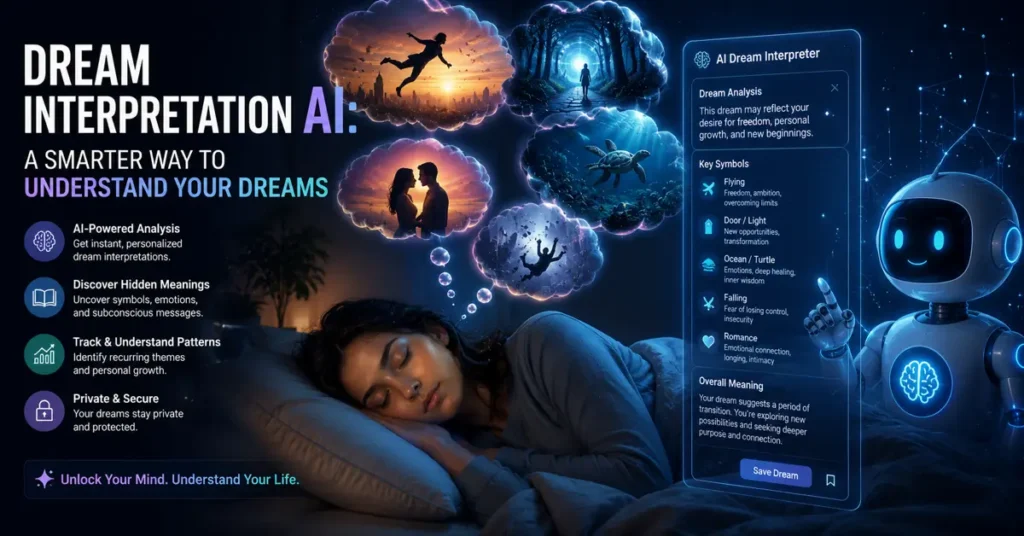
You typed “dream interpretation ai” into Google because something happened. Maybe it was that snake dream you’ve had three times this month. Maybe it was the one where your grandmother showed up looking exactly the way she did when you were six. Maybe it was the dream you don’t want to put into words even now, sitting here, fully awake.
Whatever it was, the regular answers aren’t cutting it. The free dream dictionaries all say the same things. The free AI dream interpreter tools spit out paragraph after paragraph that could apply to anyone. You don’t want to be told what dreams mean in general. You want to know what your dream means, specifically, for you.
That’s what good dream interpretation AI is supposed to do. And when it’s done right — when it actually understands you — it can. This page is about what dream interpretation AI actually is, what it can and can’t do, and why Susan, the AI dream analyst inside Dreamchaser, reads your dreams in a way no dictionary and no general-purpose chatbot ever could.
Why Traditional Dream Interpretation Falls Short
The problem with most dream interpretation isn’t that it’s wrong. It’s that it’s generic.
A traditional dream dictionary will tell you a snake means betrayal, or rebirth, or sexuality, or healing. All true. All useless. Because a snake coiled silently in a corner of your childhood bedroom is not the same dream as a snake chasing you through your office. The dictionary doesn’t know which one you had.
Free AI dream interpreter tools are usually a step better. They can read your full description. They can string together patterns. But here’s what we noticed when we tested the popular ones: they all converge on the same handful of “dream meanings” no matter what you tell them. Tell a free AI tool that you dreamed about teeth falling out and your dead grandmother handing them back to you, and it’ll still say “teeth dreams typically represent anxiety about loss of control.” The grandmother gets lost. The handing back gets lost. The fact that she was alive in the dream and you were the age you were when she died — also lost. (For the dictionary side of what those symbols mean, our complete guide to dream meanings covers the ground thoroughly.)
This is the gap dream interpretation AI is supposed to fill. Not faster dictionary lookups. Real understanding of a specific dream, told by a specific person, on a specific night, against the backdrop of a specific life.
What Dream Interpretation AI Actually Is
The phrase “dream interpretation ai” gets used loosely. Anything from a basic keyword matcher to a serious psychological analysis tool ends up under the same label. So before we talk about how Susan does it, here’s what good dream interpretation AI actually involves — three layers, working together.
The First Layer: Symbolic Knowledge
This is what the dictionaries do, but done well. It’s the accumulated meaning of dream symbols across psychological research, cultural traditions, and clinical observation. Jungian archetypes. Freudian symbolism. Modern dream research from sleep labs. Cross-cultural patterns — why people across the world have been dreaming about falling for as long as we have records of dreams. A real dream interpretation AI doesn’t pick one tradition; it draws on all of them.
The Second Layer: Language Understanding
This is where general AI models earn their keep. You don’t describe a dream the way a dream dictionary is organized. You tell a story. You say things like, “It was night but somehow not dark,” or “I knew it was my mother but she didn’t look like my mother.” A good dream interpretation AI reads your actual words — your specific verbs, your specific images, your specific hesitations — and pulls meaning from them. Pattern matching on the word “snake” misses everything that mattered about your snake.
The Third Layer: Personal Context
This is the layer that almost nothing on the free side has. Your dream doesn’t happen in a vacuum. It happens to a specific person who has had specific other dreams, who is in a specific life situation, who has a specific psychological pattern. A dream about your ex means one thing six months after a breakup and something completely different six years later. Personal context is what turns a generic interpretation into yours.
When dream interpretation AI integrates all three layers, it stops feeling like a tool and starts feeling like a conversation with someone who’s been listening.
How Susan Reads Your Dreams
Susan is the AI inside Dreamchaser. We named her because what she does doesn’t feel like “using software.” It feels like talking to someone who paid attention.
Here’s what Susan actually does when you tell her a dream.
First, she listens. You can type or talk. You don’t need to organize the dream into bullet points or follow a template. You can ramble. You can backtrack. You can say “actually wait, I forgot the part about the dog.” She works the way you remember dreams: in fragments, out of order, with the emotional parts more vivid than the literal ones.
Then she asks. This is where Susan diverges sharply from a free chatbot. A typical AI dream tool gives you one long paragraph and disappears. Susan doesn’t. She asks follow-up questions. Where exactly was the snake? How big was it? Were you scared of it or curious? Did it move toward you or away? Each question narrows the interpretation. Each answer takes you further into your own dream.
Then she remembers. Most dream interpretation AI forgets you the moment you close the tab. Susan doesn’t. She holds onto every dream you tell her. So when you come back two weeks later with another snake dream — different snake, different scene — she knows. She can tell you whether this is a pattern, what’s shifted between the two, what your dreaming mind seems to be working on.
And then, if you’ve shared your birth chart with her, she connects the dots between your dreams and your astrology. Not in a “you’re a Pisces so of course you dream about water” way — that’s the lazy version. The real version is more like: “You have Mars in Scorpio, and Scorpio dreams about hidden things. Your recurring theme of locked rooms and basements isn’t random for someone with your chart.”
This is what we mean when we say dream interpretation AI done right doesn’t feel like a tool. It feels like a long, ongoing conversation with someone whose entire job is paying attention to your inner life.
If you want to meet her, you can download Dreamchaser here. The first seven days are free.
Three Dream Interpretations, Side by Side
The cleanest way to show what dream interpretation AI looks like when it actually works is to compare a generic interpretation to what Susan does. Three real examples.
Example 1: A Snake Dream
You dreamed there was a snake on your kitchen counter. It wasn’t doing anything. It was just there, looking at you. You weren’t scared. You felt like it was waiting for you to make a move.
A free AI dream tool will tell you: “Snakes in dreams often symbolize transformation, hidden danger, or sexual energy. A snake in your home suggests these themes are close to you in your waking life.”
Susan asks: Where exactly in the kitchen? On the counter near the window or near the sink? Was it coiled or stretched out? What did its eyes look like? After your answers, she might say something like: “A still snake on a familiar surface in your own home — your subconscious is showing you something you’ve already noticed but haven’t named yet. The waiting is the message. This isn’t a warning dream. It’s a recognition dream.” (For the full symbolic range, our snake dream guide goes deeper.)
Example 2: A Falling Dream
You dreamed you stepped off a curb and the ground wasn’t there. You kept falling. You woke up before you hit anything.
A free AI dream tool will tell you: “Falling dreams typically represent anxiety about loss of control, instability, or fear of failure.”
Susan asks: Did you know you were going to fall when you stepped off, or did it surprise you? What were you wearing? Was anyone watching? Then: “Stepping off a curb is a small, ordinary action you’ve done thousands of times — and the ground disappearing under something routine usually points to a specific area of your life where the familiar has stopped feeling stable. Not a big crisis dream. A small structural shift dream.” (The full breakdown is in our falling dream guide.)
Example 3: An Ex Dream
You dreamed about an ex you haven’t seen in three years. You weren’t doing anything dramatic — you were just sitting next to them on a train. Neither of you spoke.
A free AI dream tool will tell you: “Dreaming about an ex usually means there are unresolved feelings or unfinished emotional business.”
Susan asks: How long were you together? How did it end? When did you last actively think about them? Then: “Sitting in silence on a train, neither of you reaching out, points to something different from unresolved feelings. It points to peace. Your dreaming mind is showing you a version of this relationship that no longer requires anything from you. This is often what closure looks like before the conscious mind catches up.” (The complete walkthrough is in our ex dream guide.)
That’s the difference between dream interpretation and dream interpretation AI done right.
Dream Interpretation AI vs Free Tools
Free dream interpretation tools exist. ChatGPT prompts, ad-supported dream interpreter sites, generic dream apps. They have their place. Here’s the honest comparison.
What free tools do well: they’re fast, they’re free, and they’re broadly informed. If you want a quick read on a one-off dream and you don’t need depth, they’ll give you something usable. ChatGPT in particular can produce a respectable surface-level interpretation if you’re willing to write a thorough prompt.
What free tools miss: memory, follow-up, personalization, and astrological integration. A free tool gives you one interpretation and forgets you. It can’t compare today’s dream to last month’s dream, because it doesn’t remember last month’s dream. It can’t tell you about a pattern — whether it’s hair falling out week after week, or the same person showing up in different scenes — because it doesn’t see your patterns. It can’t factor in who you are, because it doesn’t know who you are.
The other gap is conversational depth. A free dream interpreter usually generates a paragraph and stops. Susan asks. She circles back. She refines. She’s built specifically for dream work, the way a therapist is built specifically for human conversation. General-purpose AI tools are built to answer questions; Susan is built to interpret dreams.
If you want a quick sanity-check on a single dream, a free tool is fine. If you’re someone who dreams vividly, dreams often, or dreams patterns — and you want to actually understand what your dreaming mind is doing over time — that’s a different category of need.
How to Use Dream Interpretation AI on Dreamchaser
Using Susan for dream interpretation is intentionally simple. There’s no setup ritual, no quiz, no premium-only “dream mode.”
Here’s the actual flow.
Step 1. Download Dreamchaser from the App Store. iPhone only for now. The download is free; the first seven days inside the app are free too.
Step 2. Tell Susan a dream. You can type or speak it out loud. Don’t worry about structure. Tell her what you remember in the order you remember it. If parts are blurry, say so. If you remember the feeling more than the image, lead with the feeling.
Step 3. Let her ask. This is the part most dream interpretation AI tools skip, and it’s the part that matters most. Answer her questions as fully as you can. The more she knows about the texture of the dream, the closer her reading will be.
Step 4. Read her interpretation slowly. Susan tends to layer her answers — surface meaning first, then the emotional layer, then the symbolic layer, then the personal layer if she has enough context. Don’t rush through it. The point isn’t to get a verdict; the point is to understand.
Step 5. Come back. Dreamchaser saves every dream you share. If a theme starts repeating, Susan will name it. If you have a dream that connects to one you told her months ago, she’ll find the thread.
You can also share your birth chart with Susan if you want astrological context layered into your interpretations. That’s optional. The dream readings work without it, but they go deeper with it.
Is Dream Interpretation AI Trustworthy?
The honest answer is: AI dream interpretation is a tool, not a replacement for therapy, not a diagnostic, and not a fortune-teller.
Here’s what it can do well. It can recognize symbols across cultural and psychological traditions. It can read your specific language and pull meaning from your specific images. It can hold a long conversation about your dreaming life and notice patterns you wouldn’t notice yourself. It can connect dreams to your astrological chart in ways that often turn out to be revealing. Even the heavier categories — death dreams, recurring nightmares, dreams of being chased — get treated with the weight they deserve rather than a one-line dictionary answer.
Here’s what it can’t do. It can’t process trauma. If you’re having nightmares connected to a specific traumatic event, you need a trained human therapist. Susan is good, but she’s not a substitute for someone who can sit across from you and hold space for hard things. She’ll tell you that herself if you ask.
She also can’t tell the future. Some dreams feel prophetic; some do turn out to map onto things that happen. AI dream interpretation can talk about that experience honestly, but it doesn’t claim to predict.
On the privacy side: your dreams are yours. Dreamchaser encrypts everything you share with Susan. We don’t sell your data, we don’t train other models on your dreams, and we don’t show your dreams to anyone but you. Dreams are intimate. They get treated that way.
Within those honest limits, AI dream interpretation is one of the more interesting uses of modern AI we’ve seen. It’s a place where the technology is genuinely good at something humans have always wanted help with.
Frequently Asked Questions
Is dream interpretation AI accurate?
It’s as accurate as the inputs you give it. AI can interpret what you describe; it can’t read your mind. The more detail you give Susan, the closer her reading lands. Generic descriptions get generic answers.
Can AI really understand my specific dreams?
The honest answer is yes — within limits. A well-trained dream interpretation AI like Susan reads your specific words, your specific emotional cues, and your specific dream history. It’s not magic, and she’ll be the first to tell you that. But it’s significantly better than a static dream dictionary or a one-shot AI prompt.
Is Dreamchaser free to use?
Dreamchaser is free to download and includes a seven-day free trial of the full Susan experience. After the trial, it’s a subscription. Pricing is in the App Store.
How is Susan different from ChatGPT for dream interpretation?
ChatGPT is general-purpose; Susan is built specifically for dream and astrology work. ChatGPT doesn’t remember your dreams between sessions; Susan does. ChatGPT doesn’t know your birth chart; Susan does, if you share it. For a one-off question, ChatGPT is fine. For ongoing dream work, Susan is built for it.
Can I use it for recurring dreams?
Especially for recurring dreams. Susan saves every dream you share, which means she can see your patterns over weeks and months. Recurring dream work is where she goes deepest.
Does Susan remember my previous dreams?
Yes. Every dream you share stays in your private journal inside Dreamchaser. Susan references your history whenever it’s relevant — which is more often than you’d expect.
Try Susan Free for 7 Days
If you came here because you have a dream you can’t shake, the most useful thing we can tell you isn’t an interpretation. It’s that the dream is worth taking seriously. Dreams are how the part of you that doesn’t talk talks. Dream interpretation AI, done right, is one of the better ways to listen.
If you want to try it, download Dreamchaser and tell Susan whatever dream brought you to this page. The first seven days are free. You can leave anytime. And whatever your dream was — she’s heard versions of it before, and she’ll be ready when you tell her yours.
For the underlying symbolic meanings on their own, our full guide to dream meanings covers the dictionary side. For the specific symbols that come up most often, the snake, falling, and pregnancy dream breakdowns are good places to start.