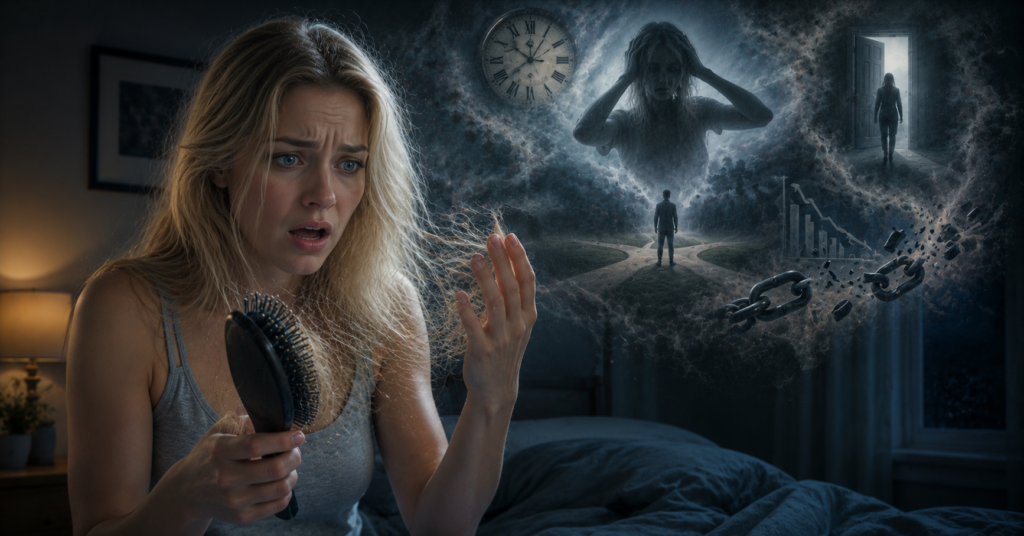
You ran your fingers through your hair in the dream and a whole handful came out. Or you were combing it, and the brush filled up. Or you looked in the mirror and there were patches missing. You woke up and reached, involuntarily, to check.
It’s still there.
But the dream isn’t gone. There’s something specific that haunts this one — different from the teeth dream, different from falling, different from being chased. The hair dream goes somewhere quieter. Somewhere closer to who you think you are.
Here’s what it’s usually about.
The short answer: A dream about your hair falling out is almost always about identity and self-image — how you see yourself, how you’re seeing yourself change, or something you’re afraid you’re losing about who you are. Less about being judged by other people (that’s more the teeth dream) and more about the version of yourself you’re quietly worried you can no longer hold onto. In our work helping people interpret this dream, the most useful question isn’t what does hair mean — it’s what part of myself do I feel like I’m losing, and have I let myself name it yet?
What this dream usually means
1. Something about your identity is shifting
Hair, in dream language, sits closer to identity than almost any other body symbol. It’s the most personally chosen thing about your body — you decide its length, its color, how you wear it. It’s tied, often deeply, to how you recognize yourself in the mirror.
When it starts falling out in a dream, your psyche is often working out a shift in who you are. Not how you look — who you are. A career change you haven’t fully grieved. A version of yourself that’s quietly retiring. A role you used to play that doesn’t fit anymore. The dream isn’t telling you to mourn it. It’s telling you it’s already happening.
This is one reason the hair dream often comes during transitions that look fine on the outside. Promotions. New relationships. Moves. Other people congratulate you. Inside, something older is being let go of, and the dream is doing the quiet work of acknowledging it.
2. A feeling that you’re aging — or that you can’t control time
Hair is one of the first visible markers of aging. Going gray. Thinning. Receding. Losing volume. It’s a body change that’s hard to entirely hide and impossible to fully control, and that combination tends to land somewhere specific in the unconscious. Hair dreams tend to recur, and Susan’s AI dream readings are designed to surface what your dreaming mind is repeating and why.
If you’ve recently had a birthday that hit harder than expected, or if you’ve been noticing your face in photos and not quite recognizing yourself, the hair-falling-out dream often shows up to give shape to that feeling. It isn’t a literal prediction of hair loss. It’s the dream of time moving in a direction I can’t slow down.
This version of the dream tends to come back more often in your late 20s, mid-30s, and around major life milestones — the moments where you become quietly aware that you’re not who you were five years ago.
3. Stress that your body is registering before your mind has
Real hair loss is one of the most documented physical responses to chronic stress. Cortisol pushes hair follicles into a resting phase, and 2–3 months later, you start seeing more strands in the shower drain than usual. It’s called telogen effluvium, and it’s real, common, and reversible.
The dream version often shows up before the physical version. Your unconscious mind picks up that your body has been holding tension for weeks — long workdays, poor sleep, not eating well, a relationship that’s draining you — and translates that into the dream image most closely tied to body integrity.
If your hair dream comes with a feeling of physical exhaustion in waking life, the dream is often less symbolic than it looks. Your body is filing a complaint your mind hasn’t fully heard yet.
4. Sometimes it really is about how you look
The more obvious reading is also sometimes the right one. If you’ve been worried about your appearance — about your hair specifically, about aging visibly, about a haircut you regret, about something a partner or friend said — the dream can simply be processing that worry directly.
This is more common than people admit. The unconscious doesn’t always speak in metaphor. Sometimes it just shows you the thing you’ve been quietly anxious about, and the most useful response is to take it at face value: I’m worried about this, and I’d like to feel better about it.
How this dream is different from the teeth dream
These two dreams come from the same emotional family, but they’re not the same dream.
The teeth dream is about being seen — perception, judgment, what other people think when you smile or talk. It’s more external. The fear in the teeth dream is usually about a moment of exposure: an upcoming presentation, a hard conversation, a public moment.
The hair dream is about being yourself — identity, self-recognition, what you see when you look in the mirror alone. It’s more internal. The fear in the hair dream is usually about a shift in who you are, that no one else may even notice but you feel quietly happening.
If you’ve been having both dreams in the same period, it usually means a transition is touching both layers: you’re changing, and you’re worried about how the change will be received.
The variation matters
The way the hair comes out in your dream points to slightly different things.
- Handfuls coming out when you touch it → an active sense of loss. Often during transitions you haven’t named yet.
- Finding strands in the brush or shower drain → slower, accumulating awareness that something is shifting. Often shows up in long stressful seasons.
- Going completely bald in the dream → a deeper identity shift. Often points to a major reinvention — voluntary or not — that you haven’t fully made peace with.
- Patches missing in specific spots → a more specific worry. Worth asking what specific part of your identity feels exposed.
- Hair falling out in clumps with no pain → resignation more than panic. Often a sign that the change is already complete; the dream is processing what happened, not warning you about it.
- Watching someone else lose their hair → projection. Often the person in the dream represents a quality of yourself you’re worried about losing.
- Hair turning gray suddenly → time-anxiety more than identity-anxiety. Often during birthdays or anniversaries of significant events.
- Hair coming back, or growing differently → less common, more interesting. Usually points to a reinvention you’re quietly excited about, even if waking life feels uncertain.
Three questions to ask yourself
If you woke up from this dream and you’re not sure what it’s pointing at, sit with these:
1. What part of myself have I been quietly letting go of? Not asking what’s going wrong — asking what’s changing. A career identity. A relationship role. A version of yourself you used to lean on. Naming it is half the work.
2. Is my body trying to tell me something my schedule has been ignoring? The hair dream sometimes arrives before stress shows up physically. If you’ve been pushing through, eating badly, sleeping less, this might be the early signal.
3. What would I look like if I stopped trying to look like the version of me from five years ago? This one is harder. The hair dream often shows up when we’re still trying to be someone we’ve already stopped being. Letting that go isn’t loss — it’s the next thing.
What different cultures have said about this dream
Hair has carried symbolic weight in nearly every culture with a recorded dream tradition, and the readings tend to land in similar territory.
In ancient Greek and Roman traditions, hair loss in dreams was often read as a warning about loss of power, status, or vitality. In traditional Chinese dream interpretation, hair is associated with life force and personal energy, and losing it in a dream has often been read as a sign of depletion. In some Hindu and Buddhist traditions, hair represents attachment — and losing it can symbolize a spiritual release rather than a worldly loss. In Islamic interpretive traditions, dreams about hair have varied readings depending on the context and the dreamer. In modern Western psychology, the consensus has landed firmly in the identity-and-self-image territory.
What all of these share is the recognition that hair carries more than it physically should. It’s a small body of fibers that, in nearly every culture across history, somehow ended up representing the self.
What Susan might say about your hair dream
When someone opens the Dreamchaser app at 3am and tells Susan they dreamed their hair fell out, the first question she asks isn’t about the hair.
She asks what’s been changing — quietly, without much fanfare — in waking life. The kind of change that doesn’t show up on a calendar but that you’ve been noticing in the way you talk about yourself.
She asks how the dream felt. Panic? Resignation? Strange relief? The feeling matters more than the visual.
She asks whether anything about your body has been getting more attention than usual — your face in photos, your reflection in shop windows, your skin, your weight. Hair is often standing in for a broader body-image conversation.
She asks whether you’re getting enough sleep. Whether you’re eating. Whether anyone has asked you, recently, how you’re actually doing.
Then she walks through what each of those signals usually points to, and asks you what you think it points to.
That’s the conversation. You don’t have to figure it out alone.
Tell Susan about your dream → free on iPhone
When this dream might be your body, not your mind
Worth being honest about: real hair shedding can happen for medical reasons, and if your dream is matching something you’ve actually been noticing in waking life — extra strands in the brush, thinning at the temples, a wider part — it’s worth getting checked.
Common reversible causes include:
- Chronic stress (telogen effluvium)
- Iron, vitamin D, or B12 deficiency
- Thyroid imbalances
- Postpartum hormonal shifts
- Sudden weight loss or restrictive eating
- Certain medications
If real hair changes are part of your experience, the dream might be your mind responding to something physical — and a quick blood panel from your GP can rule out the easy fixes before reading the dream too symbolically.
That said: even when there’s a medical cause, the dream is usually still telling you something psychological too. The two can coexist.
Related dreams worth reading
- Teeth falling out dream meaning — the closest cousin to this dream, but with a different emotional angle
- Falling dream meaning — when the loss is control rather than identity
- Dream about being naked — when identity-anxiety shows up as exposure
- Dream about your reflection — when you don’t recognize yourself in the mirror
- Recurring dreams: what they really mean — if this one keeps coming back
← Back to the full guide on dream meanings
Frequently asked questions
Does dreaming about my hair falling out mean I’m actually going to lose my hair?
No, almost certainly not. The dream is a near-universal anxiety symbol about identity, self-image, and change. People with thick healthy hair have this dream constantly. That said, if you’ve actually been noticing more shedding than usual in real life, the dream can be your unconscious flagging it before your conscious mind has registered it — in which case it’s worth a quick check-in with a doctor, not for the dream’s sake but for your hair’s.
Why does this dream keep coming back?
Recurring hair dreams almost always mean there’s an identity shift happening that you haven’t fully processed. A role you used to play that doesn’t fit anymore. An age you’ve quietly crossed. A version of yourself you’re still pretending is current. The dream returns until the conscious mind catches up with what the unconscious already knows.
Is the hair dream different from the teeth dream?
Yes. The teeth dream is more about external perception — how you’re being seen, what other people think when you talk or smile. The hair dream is more about internal identity — how you see yourself, who you think you are. Both come from the same anxiety family, but they’re pointing at different layers of the same worry.
What if I dreamed of someone else’s hair falling out, not mine?
That’s usually projection. The person in the dream is often standing in for a quality of yourself you’re worried about losing — a part of your identity you associated with that person, or a version of yourself that reminds you of them. It’s rarely a prediction about that actual person.
What if I dreamed I cut my own hair off, instead of it falling out?
That’s a different dream and a more empowering one. Cutting your own hair in a dream often represents a chosen reinvention — letting go of something on your own terms rather than having it taken from you. The hair-falling-out dream is the passive version; the cut-hair dream is the active version. Worth noting which one your psyche is sending you.
Should I be worried if I had this dream once?
No. A one-off hair dream is usually your unconscious processing a small identity-anxiety from your day or week. If it doesn’t come back, you can probably let it go. The dreams worth taking seriously are the ones that don’t leave you alone.
Ready to talk it through?
If this dream is sticking with you — if it came back, or if reading this didn’t quite click — Susan can sit with you and walk through the specifics. No per-minute charges. No wait time. Just the conversation you didn’t realize you needed.