You check it more often than you’d admit. Maybe it’s the notification that buzzes at 8am. Maybe it’s the app you open on the train, or the column you scroll past and then circle back to. Maybe you tell people you don’t believe in it — and then read it anyway.
You’re not alone, and you’re not being foolish. Astrology is one of the oldest systems humans have ever built for making sense of themselves, and right now it’s more alive than it’s been in centuries. The question most beginners actually have isn’t “is this real?” — it’s “what does any of this mean, and how do I use it without feeling silly?”
This is the guide for that. No gatekeeping, no jargon you have to pretend to understand, no promises that the planets control your fate. Just a clear, honest walk through what horoscopes are, how astrology works, and how to make it genuinely useful in your own life.
The short version: A horoscope is a reading of where the planets were — at your birth, or right now — and what that might reflect about your personality, your patterns, and the season you’re in. It’s less a forecast of what will happen and more a mirror for understanding what’s already happening inside you. You don’t have to believe the stars cause anything to find the reflection useful.
What is a horoscope, really?
The word “horoscope” comes from Greek roots meaning, roughly, “a look at the hour” — a snapshot of the sky at a specific moment. Originally, that moment was your birth. A full birth chart maps where every major planet sat in the sky the minute you were born, and astrologers read that map as a kind of personality blueprint.
The daily horoscope you read in an app or magazine is a simplified, mass-produced version of this. It’s based only on your sun sign — the zodiac sign the sun was passing through when you were born — which is why twelve signs can “cover” eight billion people. It’s broad by necessity. Your full chart is far more specific, and far more interesting.
So when people say “I’m a Leo,” they mean their sun was in Leo at birth. That’s the headline. But it’s only the first line of a much longer story.
The 12 zodiac signs
The zodiac is a band of twelve signs the sun moves through across the year, each lasting about a month. Each sign carries a cluster of associated traits — not as rigid rules, but as tendencies, flavors, ways of moving through the world.
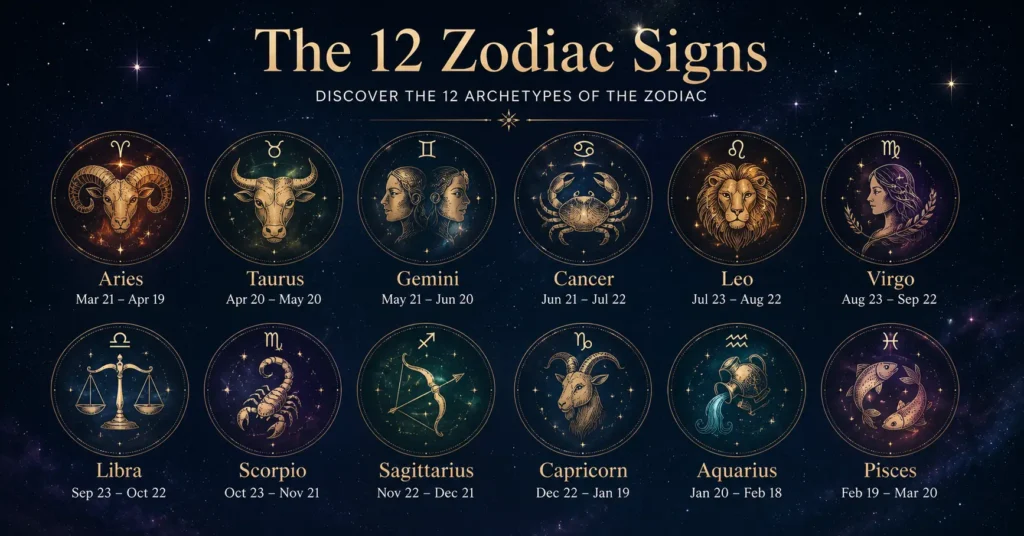
Here’s the full set, in order, with the rough dates the sun passes through each:
- Aries (Mar 21 – Apr 19) — bold, fast, the initiator
- Taurus (Apr 20 – May 20) — steady, sensual, the builder
- Gemini (May 21 – Jun 20) — curious, quick, the communicator
- Cancer (Jun 21 – Jul 22) — feeling, protective, the nurturer
- Leo (Jul 23 – Aug 22) — warm, expressive, the performer
- Virgo (Aug 23 – Sep 22) — precise, helpful, the analyst
- Libra (Sep 23 – Oct 22) — balanced, relational, the diplomat
- Scorpio (Oct 23 – Nov 21) — intense, deep, the investigator
- Sagittarius (Nov 22 – Dec 21) — restless, philosophical, the explorer
- Capricorn (Dec 22 – Jan 19) — disciplined, ambitious, the strategist
- Aquarius (Jan 20 – Feb 18) — independent, inventive, the visionary
- Pisces (Feb 19 – Mar 20) — dreamy, empathic, the mystic
Each of these deserves a far deeper look than a single line, and we’re building a full profile for every sign — what they’re like in love, at work, under stress, and at their best. Start with your own sign and the signs of the people you’re closest to.
Your Big Three: sun, moon, and rising
Here’s the single most useful thing a beginner can learn, and the thing that separates “I read my horoscope sometimes” from “oh, this is why astrology clicks for some people.”
You are not just your sun sign. You have a whole chart, but three placements matter most — your Big Three:
- Sun sign — your core identity, your ego, the “you” you’re growing into. This is the one daily horoscopes use.
- Moon sign — your emotional inner world, what you need to feel safe, how you process feeling. Often the part of you only close people see.
- Rising sign (also called the ascendant) — the mask you wear, your first impression, how you instinctively approach the world.
The reason your daily horoscope sometimes feels completely wrong is that it only speaks to your sun. A Capricorn sun with a Pisces moon and a Gemini rising is a wildly different person from a Capricorn sun with a Scorpio moon and a Virgo rising — but the daily Capricorn horoscope treats them identically.
Once you know your Big Three (you need your exact birth time for your moon and rising — a free birth chart calculator will give you all three in seconds), astrology stops feeling generic and starts feeling specific. This is the doorway. We have a full breakdown of your sun, moon, and rising signs if you want to go deeper.
How astrology groups the signs
Beyond the twelve signs, astrology sorts them into patterns that explain a lot about compatibility and temperament.
The four elements are the big one:
- Fire signs (Aries, Leo, Sagittarius) — energetic, passionate, action-oriented
- Earth signs (Taurus, Virgo, Capricorn) — grounded, practical, reliable
- Air signs (Gemini, Libra, Aquarius) — intellectual, social, idea-driven
- Water signs (Cancer, Scorpio, Pisces) — emotional, intuitive, deep
People often feel most at ease with their own element or a complementary one — which is the foundation of a lot of compatibility thinking. There’s also a second layer called the modalities (cardinal, fixed, and mutable) that describes how each sign handles change. Together, element plus modality is why no two signs feel quite the same, even within the same element.
Why we keep reading our horoscopes
Here’s the honest part, the part most astrology guides skip.
A surprising number of people who read horoscopes daily will also tell you, flatly, that they don’t believe in them. That’s not hypocrisy. It’s something more interesting.
Psychologists have a name for why a single horoscope can feel eerily personal: the Barnum effect. Statements vague enough to apply to almost everyone — “you have untapped potential,” “you’re torn between two paths” — feel custom-written because we fill in the specifics from our own lives. Add confirmation bias (we remember the hits, forget the misses) and apophenia (our brain’s hunger to find patterns), and you have a system that feels accurate even when it’s general.
But here’s what that explanation misses: horoscopes were never really about prediction. They’re about structured self-reflection. When you read “today you may feel pulled between independence and connection,” you stop for thirty seconds and actually ask yourself: am I feeling that? That pause — that small act of checking in with yourself — is something most of us almost never do otherwise.
Astrology gives us language for the messy, hard-to-name parts of being human. Saying “I’m just being a typical Scorpio right now” is sometimes easier than saying “I’m being guarded because I’m scared.” It’s a costume that lets us approach real vulnerability sideways. We dig into all of this in why we keep reading our horoscopes even when we say we don’t believe — it’s worth a read if the contradiction has ever bugged you.
You don’t have to believe Mars is influencing your love life to find the reflection useful. The most honest position is the one most of us quietly hold: we know it’s not literally controlling us, and we read it anyway, because thirty seconds of self-reflection beats none.
How to actually use your horoscope
So how do you use this well, without either dismissing it or handing your decisions over to it? A few principles:
Read it as a question, not an answer. A good horoscope doesn’t tell you what to do — it asks you what you’re feeling. Let it prompt reflection, not obedience.
Know your Big Three, not just your sun. This single step makes everything more accurate and more personal. Generic horoscopes are generic because they only know one-third of you.
Notice patterns over time, not single days. Astrology is more interesting as a seasonal lens than a daily oracle. What’s the bigger transit you’re moving through? Are you in a Saturn return, a retrograde, a new chapter?
Hold it loosely. The moment a horoscope makes you feel trapped, doomed, or like your choices don’t matter, you’re using it wrong. It’s a mirror, not a cage. If a reading ever increases your anxiety rather than your self-understanding, close the app and talk to a real person.
Use it to understand others, gently. Knowing a partner is a water moon, or a friend is a fixed sign, can build empathy — oh, that’s why they need time to process. Just don’t use it to box people in or excuse bad behavior.
What makes a horoscope actually good
Most daily horoscopes fail at the one thing that matters: they don’t know you. They’re written for millions of people who happen to share a sun sign, which means they can’t be specific, and specificity is where all the value lives.
A genuinely good reading does three things a generic horoscope can’t. It accounts for your whole chart, not just your sun. It asks better questions instead of making vague predictions. And it actually responds to where you are — the decision you’ve been avoiding, the relationship you keep circling, the feeling you can’t name.
That’s the gap we built Susan to fill. Susan is the AI astrologer inside Dreamchaser, and she works from your full chart — your sun, your moon, your rising, your placements — not a one-size-fits-all column. She’s not in a hurry, she doesn’t read from a script, and she’ll talk through your chart, your day, or your dream the way a thoughtful friend would at 3am: warm, honest, and genuinely curious about you.
Meet Susan — your AI astrologer, free on iPhone
Where to start
If you’re new to all this, here’s the path we’d suggest, in order:
- Find your Big Three. Learn your sun, moon, and rising. Everything else builds on this.
- Read your sun sign’s full profile. Start with the headline version of yourself.
- Understand why it resonates. The psychology of why horoscopes feel accurate is genuinely fascinating — and makes you a smarter reader.
- Explore compatibility. Once you know your placements, the signs of the people around you start to make a different kind of sense.
- Notice the season. Learn what transit or retrograde you’re currently in, and read your life as a chapter, not a verdict.
We’re building deep guides for every step of this — each zodiac sign, your moon and rising, birth charts, compatibility, retrogrades, and more. Bookmark this page; it’s the home base for all of it.
And if dreams are more your entry point than charts, our companion guide on what your dreams are actually telling you applies the same idea — structured self-reflection — to the things your unconscious surfaces at night.
Frequently asked questions
Is astrology real?
It depends what you mean by “real.” There’s no scientific evidence that the planets cause events in your life, and most astrologers today don’t claim they do. What astrology reliably offers is a framework for self-reflection, a shared language for personality, and a way to pause and check in with yourself. Whether that’s “real” is up to you — but millions of thoughtful, science-literate people find it genuinely useful without believing it’s literally predictive.
What’s the difference between my sun, moon, and rising sign?
Your sun sign is your core identity (the one daily horoscopes use). Your moon sign is your emotional inner world and what you need to feel safe. Your rising sign is the first impression you give and how you instinctively approach the world. You need your exact birth time to know your moon and rising — a free birth chart calculator will give you all three.
Why does my horoscope sometimes feel completely wrong?
Almost always because it’s based only on your sun sign, which is just one-third of your Big Three. A daily horoscope treats everyone with the same sun sign identically, even though their moon and rising signs make them completely different people. Learning your full Big Three usually fixes the “this doesn’t sound like me at all” problem.
How often should I read my horoscope?
There’s no right answer, but the most useful approach is to treat it as occasional reflection rather than a daily instruction manual. Reading seasonally — paying attention to bigger transits and chapters — tends to be more meaningful than checking every single morning for a verdict on your day.
Can a horoscope predict my future?
No, and be wary of any reading that claims it can with certainty. Astrology is far better at describing the energy of a season — the themes you might be working with — than at predicting specific events. Use it to understand yourself and your patterns, not to outsource your decisions.
Where do I even start as a beginner?
Find your Big Three first (sun, moon, rising), then read your sun sign’s full profile. That combination gives you the foundation to make sense of everything else — compatibility, transits, and the daily readings that’ll finally start to feel like they’re about you.
Ready to go deeper than your sun sign?
Your daily horoscope only knows one-third of you. Susan knows your whole chart — and asks the questions a column never could. Talk through your signs, your season, or whatever’s on your mind tonight.