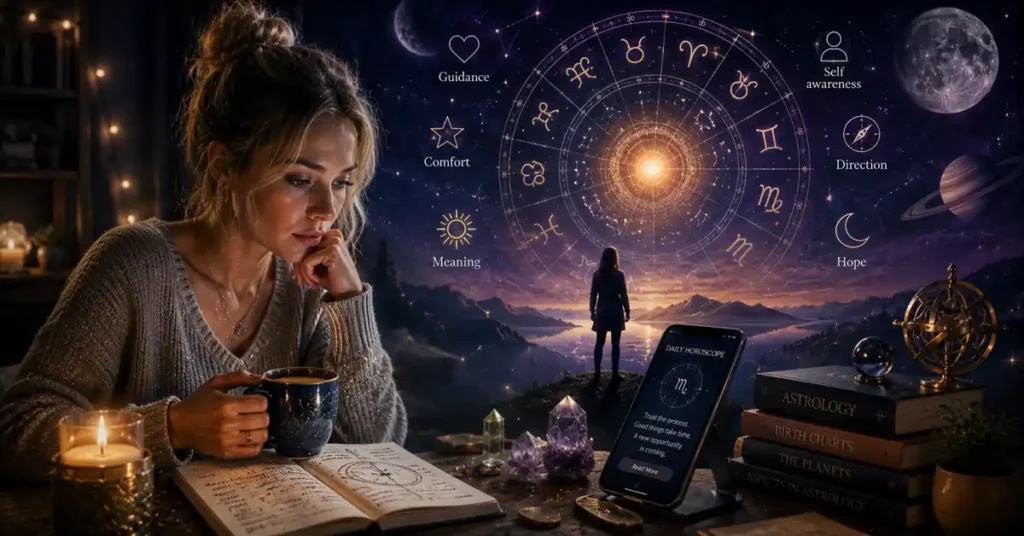
You’re standing in line at the coffee shop. Your phone buzzes — a daily horoscope notification. You glance around to make sure no one’s watching, then tap to read.
“You may feel torn between two paths today, Sagittarius. Trust your instincts.”
You laugh. Roll your eyes. “Astrology isn’t real,” you tell yourself. And then, just for a second, you think about that decision you’ve been putting off — and wonder if maybe, just maybe, the stars are onto something.
If this sounds familiar, you’re in good company. Astrology is having a moment that refuses to end. The global astrology market is projected to surpass $22 billion in the coming years. Apps like Co–Star, The Pattern, and Sanctuary have collectively been downloaded tens of millions of times. Walk into any bookstore and you’ll find an astrology section that didn’t exist a decade ago. Surveys consistently find that around three in ten American adults say they believe in astrology, with younger generations leading the charge.
So what’s actually going on? Why are smart, science-literate people checking their horoscopes alongside their stock portfolios?
The Barnum effect: why horoscopes feel so personal
In 1948, psychologist Bertram Forer ran an experiment that’s now legendary. He gave each of his students a “personality analysis” supposedly based on their individual test results, then asked them to rate the accuracy from 0 to 5. The average rating: 4.26 — almost perfect.
The catch: every student received the exact same analysis. Forer had cobbled it together from a newsstand astrology column.
The phenomenon is now called the Barnum effect (after showman P.T. Barnum) or the Forer effect, and it explains why a single horoscope can feel like it was written specifically for you. Statements like “You have a great deal of unused capacity which you have not turned to your advantage,” or “At times you are extroverted and sociable, while at others reserved and reflective” feel deeply personal — but they’re true of almost everyone.
Horoscope writers have spent centuries refining this art. They use language specific enough to feel meaningful and vague enough to be universally true. “A person from your past may resurface this week” works because we all have people in our past. “Trust your intuition about a recent decision” works because we’re all currently making decisions and second-guessing ourselves.
Pattern recognition gone wild
Beyond the Barnum effect, there’s another reason horoscopes click: our brains are evolved pattern-recognition machines. We see faces in clouds, hear meaning in random noise, and find narratives in coincidence. Psychologists call this apophenia — the tendency to perceive meaningful connections between unrelated things.
When your horoscope says “You’ll have an unexpected encounter today,” you’re primed. Every encounter becomes evidence. The barista who smiles a little longer? Unexpected encounter. The text from a friend you haven’t heard from in months? Unexpected encounter. The cousin who shows up at your aunt’s birthday? Definitely unexpected.
What we don’t notice are all the ordinary days that match horoscope predictions for other signs. We only count the hits. This is confirmation bias — the silent partner of every horoscope on the internet.
So why do we keep doing it?
Here’s where it gets interesting. If horoscopes are demonstrably built on cognitive shortcuts, why hasn’t psychology killed them off? Why are they more popular now than they were when astrologers genuinely believed they were tracking celestial influences on human destiny?
Because horoscopes were never really about predicting the future.
They’re about structured self-reflection. When you read “Today you may feel pulled between independence and connection, Libra,” you stop for thirty seconds and actually think: Am I feeling that? You audit your own emotional state, something most of us almost never do otherwise. The horoscope is a mirror, not a forecast.
They’re about language for things we struggle to name. Astrology gives us a vocabulary — “Mercury retrograde,” “Venus in your seventh house,” “your moon sign” — for the messy, contradictory parts of being human. Saying “I’m just being a typical Capricorn right now” is sometimes easier than saying “I’m being controlling because I’m scared.” The first one is a joke between friends. The second one requires actual vulnerability.
They’re about community. “What’s your sign?” has become one of the easiest icebreakers of the modern era — a low-stakes question that opens into something surprisingly personal. In an age of fragmented friendships and algorithm-curated isolation, that matters more than we like to admit.
And they’re about meaning — the most embarrassing word in our vocabulary. We live in a culture more comfortable with irony than sincerity. Saying “I want my life to mean something” out loud feels almost humiliating. Saying “I’m a Pisces sun, Cancer moon, Scorpio rising — that’s why I’m so sensitive” is socially safe. It’s the same question, dressed up in a costume that doesn’t ask too much of us.
The honest take
You don’t have to believe Saturn is influencing your career to find your horoscope useful. You don’t have to dismiss it as nonsense to consider yourself a rational person. The most honest position might be the one most of us secretly hold: we know it’s not literally true, and we read it anyway, because thirty seconds of structured self-reflection beats no self-reflection at all.
The stars aren’t telling you what to do. But the act of pausing — of asking what am I actually feeling right now? — that’s real. That’s worth something. (If you want to actually understand the system behind the column — your sun, moon, and rising signs, how it all fits together — that’s a different and deeper kind of useful.)
So go ahead. Check your horoscope tomorrow morning. Roll your eyes when it nails something a little too accurately. Forward the screenshot to the group chat. Then maybe, for just a second, sit with the question it asked you.
The Sagittarius in line at the coffee shop already knew this. She just couldn’t admit it out loud.
P.S. — A horoscope that actually asks better questions
The thing most daily horoscope apps miss is the part that matters most: the question. A short prediction that’s vague enough to be universally true does nothing for you. A reading that pauses, asks what you’re actually feeling, and then sits with you in the answer — that does a lot.
That’s what we tried to build with Susan, the AI astrologer inside Dreamchaser. She isn’t in a hurry, she doesn’t read from a script, and she’ll ask you about your sun, your moon, and your rising — and then ask you something more useful: what’s the one decision you’ve been putting off?
Read your horoscope with Susan → free on iPhone
Free 7-day trial. No per-minute charges, ever.
Related reading
- Horoscopes: A Complete Beginner’s Guide — the full guide to astrology, your Big Three, and how to actually use your horoscope
- Dream Meanings: What Your Dreams Are Actually Telling You — the same kind of structured self-reflection, applied to the things your unconscious surfaces at night
- Teeth falling out dream meaning — one of the most common anxiety dreams, and what it usually points to